

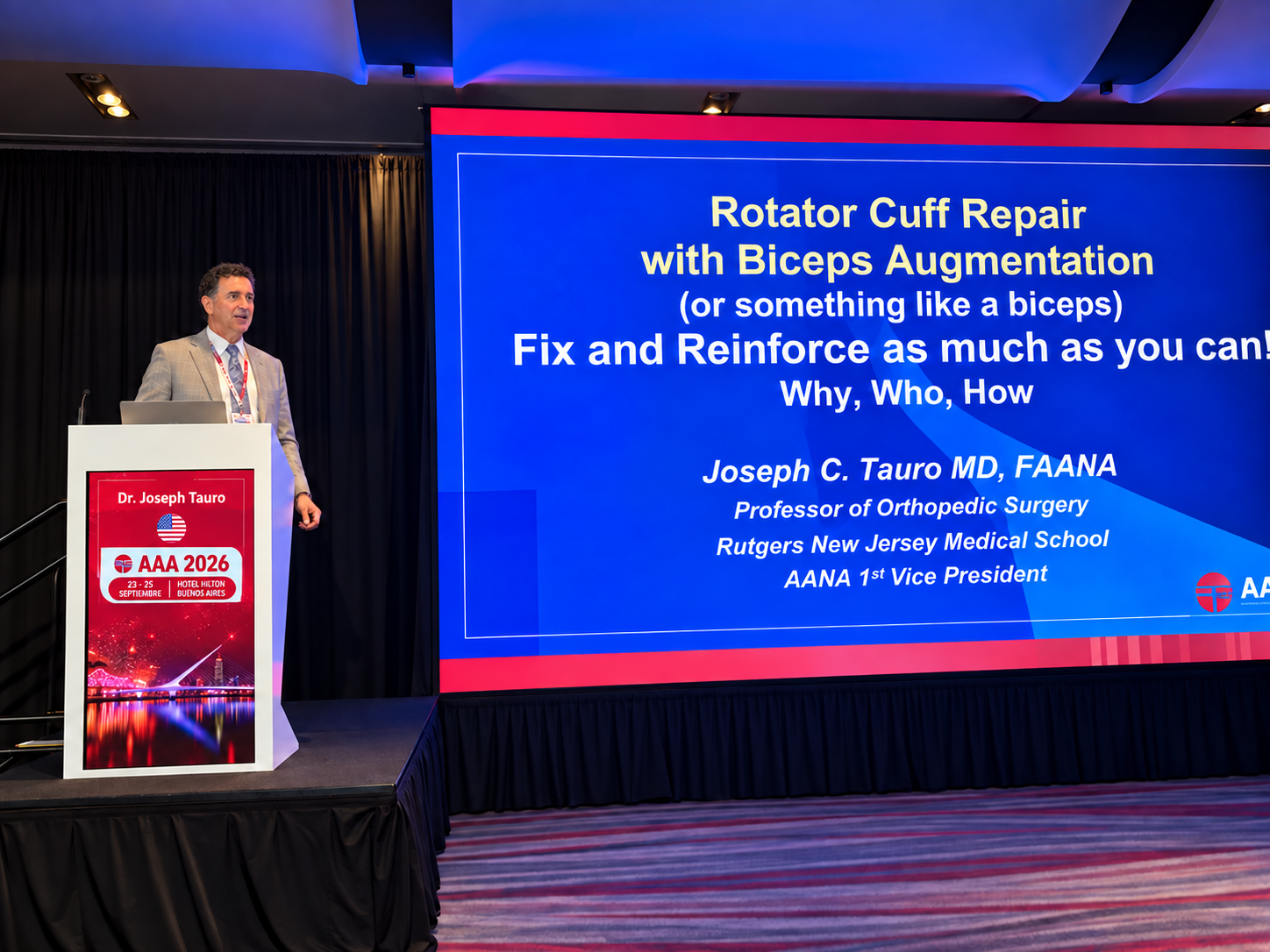
Advanced Orthopedics and Sports Medicine Institute’s (AOSMI) Dr. Joseph Tauro joined surgeons from around the world in Buenos Aires, Argentina, as a speaker at the 18th International Congress of the Argentine Arthroscopy Association (AAA 2026). Held September 23 to 25, 2026, the meeting gathered more than 800 medical professionals from the United States, Canada, France, Italy, Brazil and Mexico.
His part of the program focused on two shoulder problems that affect many active people. The first was large rotator cuff tears, which can often be repaired with shoulder arthroscopy instead of replacing the joint. The second was shoulder dislocations in young athletes, where the timing of care after a first injury can affect which treatment options are available later.
What You’ll Learn
- What Dr. Tauro spoke about at AAA 2026
- How large rotator cuff tears can be repaired instead of replaced
- How your own biceps tendon can add support to a repair
- Why early care matters after a shoulder dislocation
Why Dr. Tauro Spoke at AAA 2026
Meetings like AAA 2026 give surgeons from different countries a chance to compare approaches and learn from one another. Dr. Tauro was one of many speakers on the program, and he shared his experience with two shoulder problems that orthopedic surgeons see often: large rotator cuff tears and shoulder dislocations in young athletes.
Dr. Tauro has spent decades performing and teaching arthroscopic shoulder surgery. He serves on the Board of Directors and is a Master Instructor for the Arthroscopy Association of North America (AANA). The group honored him with its 2025 Distinguished Service Award.
He also trains future surgeons at Rutgers New Jersey Medical School and helps create new tools and techniques for shoulder surgery.
“Teaching in Buenos Aires was an honor. When surgeons from different countries share what works, patients everywhere benefit, including the patients we care for right here in New Jersey,” says Joseph Tauro, MD.
Can a Torn Rotator Cuff Be Fixed Without Replacing the Shoulder?
The first topic Dr. Tauro spoke about in Buenos Aires was how surgeons approach large rotator cuff tears, and when those tears can be repaired rather than treated with a shoulder replacement.
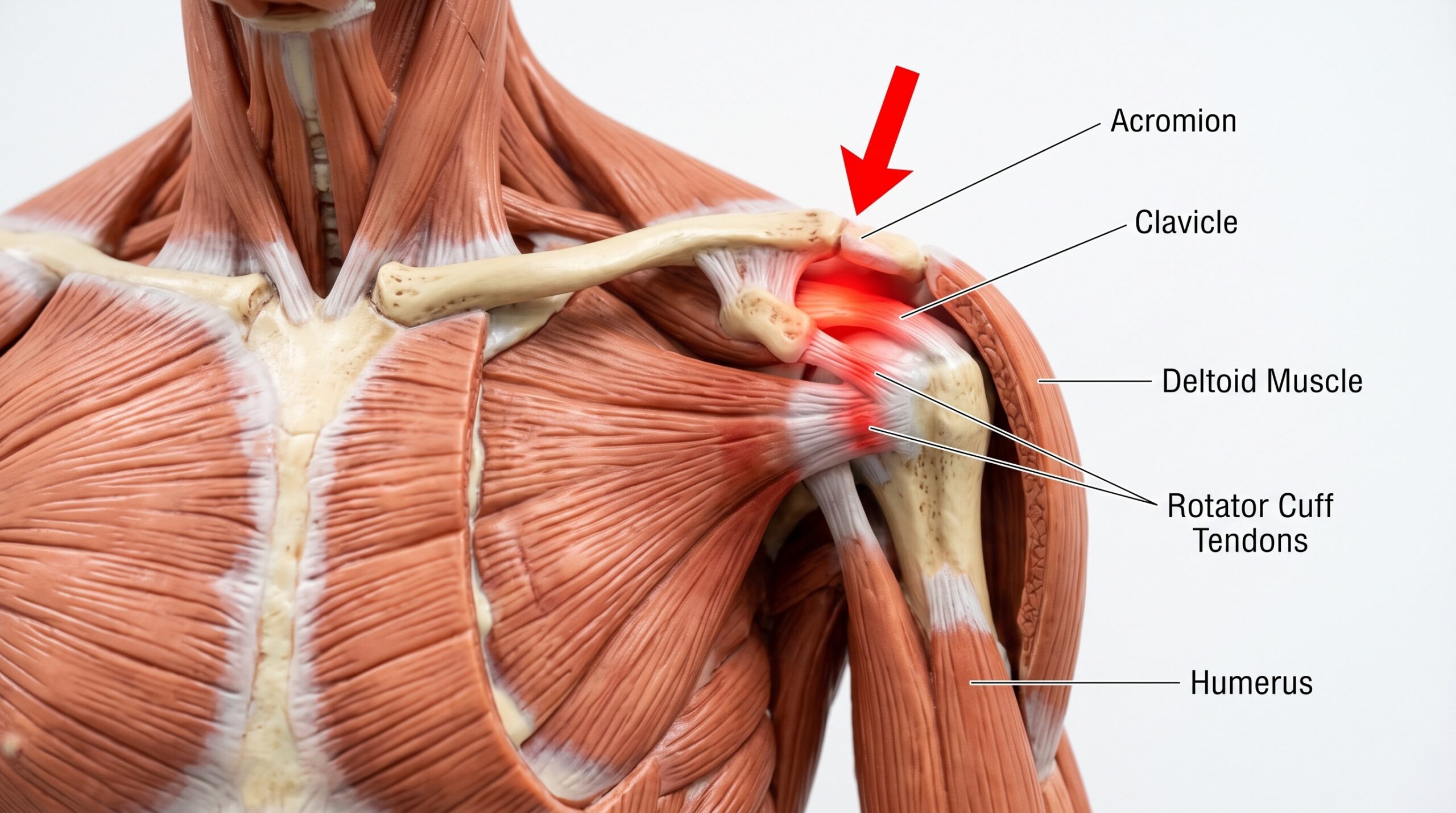
Your rotator cuff is a group of four muscles and tendons that keep the top of your arm bone centered in the shoulder socket. It helps you lift a grocery bag, throw a ball or reach a high shelf.
When a tear gets very large, the tendon can pull back away from the bone and the muscle can weaken over time. For years, shoulder replacement was often the main treatment option for tears like this.
Today, shoulder arthroscopy offers another option for many of these tears. Working through a few small cuts with a tiny camera, the surgeon uses stronger anchors and improved stitch patterns to reattach the tendon to the bone, and tissue implants can add support while it heals. The goal is to keep your own shoulder joint whenever possible.
“A large rotator cuff tear doesn’t automatically mean a shoulder replacement. If we can save a patient’s own shoulder, that’s where we start,” explains Dr. Joseph Tauro.
How Can Your Own Biceps Tendon Help a Rotator Cuff Repair?
Dr. Tauro also spoke about using the biceps tendon to reinforce a rotator cuff repair. One part of the biceps tendon runs through the top of the shoulder, right next to the rotator cuff, which makes it a natural source of extra support.
During surgery, the surgeon moves this part of the tendon over the repair to add an extra layer of tissue. Because the tendon stays attached, it keeps its own blood supply, which can support healing.
Who Is a Good Fit for This Type of Repair?
A good candidate usually has a large rotator cuff tear that can still be repaired, tendon tissue that is thin or weak, and a healthy biceps tendon. This approach is usually not an option if the biceps tendon is badly frayed or torn, if it was released or moved in an earlier surgery, or if the shoulder already has advanced arthritis.
Why Does Early Treatment Matter After a Shoulder Dislocation?
For many young athletes, the first dislocation is the right time to talk about preventing the next one. Dr. Tauro’s second topic was early arthroscopic treatment, which research shows can greatly lower the chance of the shoulder coming out again, especially in athletes.
A dislocation happens when the ball of the shoulder is forced out of its socket, often during a tackle, a hard fall on an outstretched arm or a collision in sports. It can tear the labrum, a ring of cartilage that helps hold the ball in place, and in young athletes this tear frequently does not heal well on its own.
A review of research studies found that about 6% of patients with a first-time dislocation had their shoulder slip or feel unstable again after surgery to stabilize it. For patients treated with only a sling, that number was about 47%.
What Happens If Treatment Is Delayed?
Each new dislocation can tear more cartilage and wear away bone at the edge of the socket. Once too much bone is gone, a small arthroscopic repair may no longer be enough, and the athlete may need a bigger, more invasive surgery.
Not every first dislocation needs surgery, and the right choice depends on things like your age and how much damage the injury caused. Seeing a shoulder surgeon soon after the injury can help you understand your options.
“For a young athlete, the first dislocation is the time to get it checked. Each time the shoulder comes out again, there can be more to repair,” says Dr. Joseph Tauro.
Shoulder Care Topics at a Glance
| Topic | What It Means for Patients |
| Repairing large rotator cuff tears with arthroscopy | Some patients can keep their natural shoulder instead of having it replaced |
| Using the biceps tendon to support a repair | Adds strength from tissue already in your shoulder |
| Treating shoulder dislocations early | Can lower the chance of the shoulder coming out again |
| Checking for bone loss after a dislocation | Bone loss at the socket affects which type of repair can work |
Frequently Asked Questions
What Is Shoulder Arthroscopy?
Shoulder arthroscopy is surgery done through a few small cuts. The surgeon uses a tiny camera and thin tools to see and repair problems inside the joint.
Is Every Rotator Cuff Tear Repairable?
Not every rotator cuff tear can be repaired. Your surgeon looks at the size of the tear, the health of the tendon and muscle, and how you use your shoulder day to day, and uses an exam and an MRI to help decide whether a repair is right for you.
Should I See a Doctor After My First Shoulder Dislocation?
Yes. If your shoulder went back into place on its own, make an appointment with a shoulder surgeon, who can check for labrum tears and bone damage and explain your risk of it happening again. If it is still out of place, do not try to put it back in yourself. Get care right away at an orthopedic urgent care or emergency room, then follow up with a shoulder surgeon.
Where Can I See Dr. Joseph Tauro?
Dr. Tauro sees patients at AOSMI’s Toms River office. To book an appointment with Dr. Joseph Tauro in the Toms River location, call 732-341-6226.
When Should I See a Doctor About Shoulder Pain?
It may be time for an appointment if you notice:
- Shoulder pain that wakes you up at night
- Weakness when you lift your arm
- Pain when you reach overhead or behind your back
- A shoulder that has popped out of place or feels loose and unstable
AOSMI offers surgical and non-surgical shoulder care throughout New Jersey. If shoulder pain or instability is getting in the way of work, sleep or sports, call the AOSMI team at 732-720-2555 or request an appointment online.
*This article is for general educational purposes only and should not be taken as medical advice. Every patient is different, and AOSMI does not recommend a diagnosis or treatment without an appropriate clinical assessment. If you have questions about your symptoms, speak with a qualified healthcare professional.