

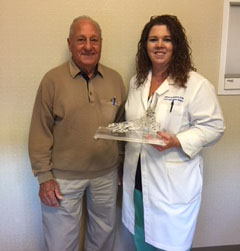
Dr. Alison DeWaters holds a model of an ankle replacement prosthesis while standing with Herbert Hock, whose ankle she replaced in April 2019.
Treating Ankle Pain with STAR Ankle Replacement
Patient is pain free after ankle replacement
Before he had ankle replacement surgery in April 2019, 90-year old Herbert H. experienced debilitating pain from the bone-on-bone arthritis in his ankle. Forced by the pain to limp and give up his favorite activities including skiing and riding his motorcycle, he says he had “no quality of life.”
Thanks to STAR Ankle replacement surgery performed by foot and ankle surgeon Dr. Alison DeWaters, Herbert is active again, and even looking forward to getting back on his motorcycle. Dr. DeWaters is a board-certified podiatric surgeon at Advanced Orthopedics and Sports Medicine. She received her degree in Podiatric Medicine from Temple and completed a four-year residency in podiatric reconstructive foot and ankle surgery at the University of Pennsylvania.
“The STAR implant is a great alternative to an ankle fusion with increased mobility and a decreased risk of surrounding joint arthritis after,” Dr. DeWaters says.
At his six month checkup in October, Herbert was walking and no longer in pain. “I couldn’t be happier,” he says. “Dr. DeWaters is the best.”
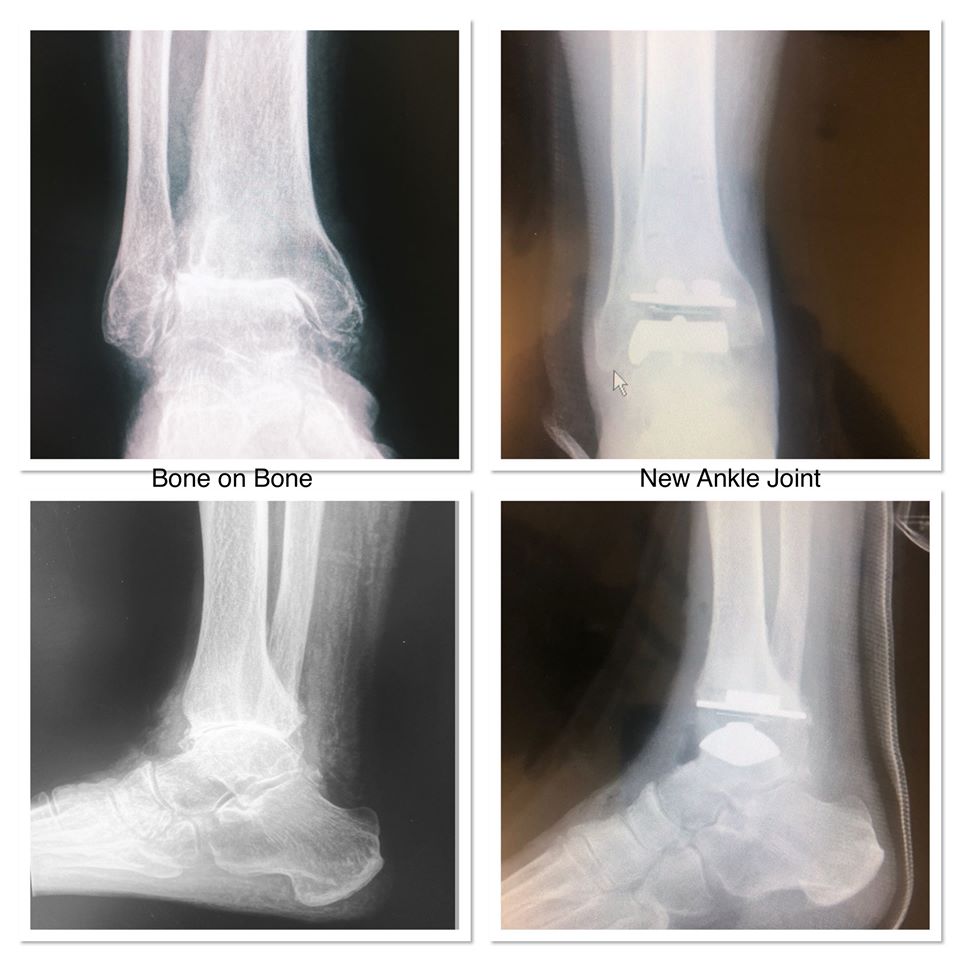
Prior to ankle replacement surgery, Herbert Hock’s ankle joint was bone-on-bone, which caused debilitating pain.
What is total ankle replacement surgery?
Total ankle replacement is a surgical procedure that replaces the damaged bone and cartilage in the ankle joint with an artificial implant. It is performed to treat painful conditions of the ankle, such as arthritis. It is designed to relieve pain while still allowing you to move your ankle. When conservative treatments such as pain medications no longer help alleviate pain, your doctor may recommend ankle replacement.
What is the STAR Ankle System?
The ankle joint (tibiotalar joint) is the area where the bottom of the shin bone (tibia) rests on top of a bone in the foot called the talus bone. The shin bone is the long bone that runs from the bottom of your knee to the top of your ankle.
STAR stands for Scandinavian Total Ankle Replacement, designed by a well-known surgeon in Scandanavia. The STAR Ankle is made up of three parts. The first part covers the talus bone. The second part covers the very bottom of your shin bone. Both of these parts are made of a combination of metals called cobalt chromium alloy. These parts are covered with another metal, pure titanium, in the places where they actually touch your bone.
The third part of the STAR Ankle is called a Mobile Bearing and is placed in between the two metal parts. The Mobile Bearing is made out of medical grade plastic called polyethylene and is designed to move in between the metal parts as you move your ankle.
“Patients walking is significantly improved after the implant over a fusion,” Dr. DeWaters says.
The STAR Ankle procedure requires the surgeon to make a cut along the front of the ankle to open the ankle joint. A small portion of bone is then removed from the ankle joint to make space for the metal and medical grade plastic parts. Unlike other ankle replacement systems, the STAR Ankle does not require the use of bone cement. Unlike ankle fusion, the STAR Ankle allows more mobility.
What are the similarities and differences between the STAR Ankle and other ankle replacements?
With all ankle replacement surgeries, metal components replace the bone surfaces of the ankle. As mentioned previously, with STAR Ankle replacement, the two metal parts are separated by the Mobile Bearing, which is designed to mimic the natural motion of the ankle as you do daily activities like walking. All other ankle implants in the U.S. have the plastic attached to one of the metal parts.
The STAR Ankle is the only ankle replacement used in the United States that attaches directly to your bone without the need for bone cement. Ankle implants, other than the START Ankle, require the use of bone cement to attach the implants to the bone.
Recovery after STAR Ankle Replacement
Most patients are in the hospital for two or three days. Some patients have shorter stays, while others may stay in the hospital for longer than five days. Typically, prior to putting any weight on your ankle, you may use crutches or a walker for a minimum of two weeks after surgery. Your doctor will let you know when you may begin putting some of your weight on your ankle. You will be required to see a physical therapist, who will teach you exercises that will help you move more easily. You most likely won’t be able to put any weight on the ankle for a few months. You will have to wear a fitted booth for several months.
What activities can you do after recovering from ankle surgery?
After an ankle replacement, you may be able to do as much walking and swimming as you like. You may also participate in non-impact activities, such as golf. You should not run, jump, perform heavy lifting or manual labor unless your surgeon allows it. These types of activities may cause the ankle replacement to loosen or break. This may require further therapy, or even surgery. Ask your surgeon about other activities you’re interested in to find out if they’re okay for you to do. Keeping your weight down and not smoking are things that may help increase the life of an ankle replacement.
Risks with Ankle Replacement
As with any surgery, there are potential risks with ankle replacement. Some risks include misalignment of the bones, loosening of the artificial components over time and wearing out of the components.
Results of Ankle Replacement
Ankle replacement will help you decrease or get rid of your ankle pain. It will increase your ankle’s mobility and allow you to move your ankle up and down. Depending on your health, activity level and amount of damage to your ankle joint before surgery, an ankle replacement can last 10 years or more in most cases.


The benefits of running, jogging, or walking to your health and wellbeing seem endless. Although it might be tempting to take the winter off from your running routine, the colder months are one of the most important times of the year to stay active. Our orthopedic specialists encourage patients to maintain exercise year round in order to keep joints healthy and flexible, to remain at a healthy weight, to reduce inflammation, and to benefit from the feel-good brain chemicals released during exercise.
Here are some tips and strategies to stick to your activity schedule this winter.
- Upgrade Your Gear. Your health is worth investing in. Purchasing a new pair of running shoes, in addition to some warm, layered exercise outfits, will help you get motivated and excited about getting out to run. Having the appropriate footwear, warm clothing, and reflective material will also help to keep you safe while you workout, particularly outdoors.
- Stick to a Schedule. Running at the same time of day will help you to develop a routine that you can maintain. If you know the only way to fit in your run consistently is in the morning, then start waking up earlier to give yourself that extra “you” time.
- Buddy Up. Having a workout buddy to run with can do wonders for motivation. It’s much easier to cancel on yourself than to cancel on someone you made plans to workout with.
- Build a Backup Plan. Inclement weather is a harsh reality in the winter months. Unfortunately, running outdoors is sometimes just not feasible. Luckily, there are many low-cost gym membership options, and some local recreation centers offer access to cardio equipment for free!
Proper form while running is important at all times of year to prevent strain on the joints and muscles. If you are new to running, looking to start, or are experiencing pain after you run, an orthopedic specialist at AOSMI can help. Contact us today to learn more.
 I have had two unfortunate incidents and had needed Dr. Cozzarelli and staff Advanced Orthopedics and Sports Medicine Institute.
Never would I take the time tow rite a letter to compliment or complain. But in this case I feel this extraordinary group needs to be recognized.
September 7th, I crushed my tibia plateau and my ankle in a horrible accident. On September 8th of 2015, Dr. Cozzarelli did surgery on my leg where he put about ten screws and a plate in my Tibia to rebuild the Plateau and several screws in my ankle. The prognosis was good and Dr. Cozzarelli was on point with every step of my recovery (no pun intended).
Then I had the second incident, I slipped on the ice, and Dr. Cozzarelli did orthoscopic surgery on my knee. Going into surgery was surreal, no apprehension, no anxiety, just ultimate confidence. I walked out of the hospital several hours later.
The team of professionals, that support his efforts also outstanding. From the moment they greet you until you leave their offices you will be treated as if you were royalty.
You and your staff have my most sincere thanks, trust and highest regards.
Yours truly.
Shawn M
 I would like to thank Dr. Dan and all the nursing staff for your kindness and for the quality of nursing I received whilst in Centra State. I could have hoped for a better hospital to find myself in. My orthopedic specialist here, Dr. Jeff Peereboom was very impressed with the excellent work Dr. Gregg Berkowitz did on my ankle so could you please send him my regards and special thanks you also could say special hello to Dr. Dan from my granddaughter Shelly and let him know that the weekend after we got home she did a cheer competition at the Gold Coast and were overall Grand Champion. Thanking you all again for everything.
Karen M (with the broken ankle)
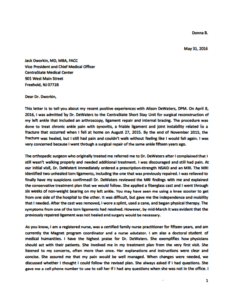 Dear Dr. Dworkin,
This letter is to tell you about my recent positive experiences with Alison Dewaters, DPM. On April 8, 2016, I was admitted by Dr. Dewaters to the CentraState Short Stay Unit for surgical reconstruction of my left ankle that included an arthroscopy, ligament repair and internal bracing. The procedure was done to treat chronic ankle pain with synovitis, a friable ligament and joint instability related to a fracture that occurred when I fell at home on August 27, 2015. By the end of November 2015, the fracture was healed, but I still had pain and couldn’t walk without feeling like I would fall again. I was very concerned because I went through a surgical repair of the same ankle fifteen years ago.
READ MORE