

You settle onto your side and finally get comfortable, only to notice an ache where your knees touch. Separating your legs or changing positions may help ease discomfort even. In other cases, the same knee continues to bother you no matter how many times you change positions.
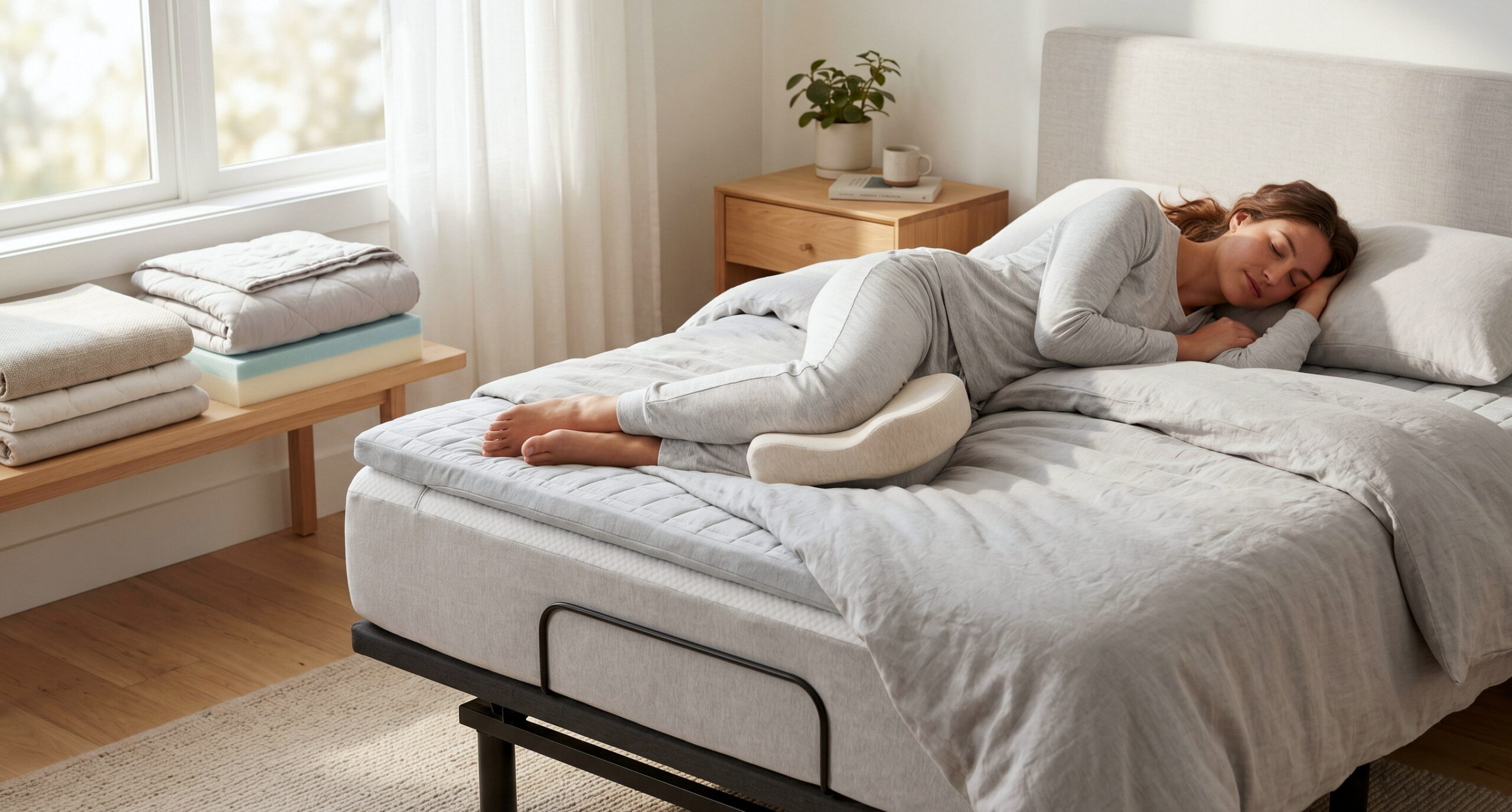
Side sleeping itself is not bad for your knees or your back. The way your legs are supported, however, can make a difference. When one knee rests directly on the other, pressure builds where the knees meet. At the same time, the upper leg can fall forward, allowing the hip and pelvis to rotate and changing the position of the lower back.
Supporting the legs can reduce direct pressure on the knees and help the hips and lower back rest more comfortably. If a small change in position brings relief, sleep position is likely contributing. Pain that continues in other positions or during the day can point toward an issue within or around the knee itself.
What You’ll Learn
This article explains:
- Why your knees can hurt when they touch during side sleeping
- How side sleeping can affect the knees, hips, and lower back
- How added support can make side sleeping more comfortable
- What other knee problems can become more noticeable at night
- When nighttime knee pain is worth having evaluated
Why Does My Knee Hurt When I Sleep on My Side?
When you sleep on your side, one knee often rests against the other while the upper leg can drift forward as your body relaxes. Direct contact can put pressure along the inside of the knee, while movement of the upper leg can also change the position of the hip and pelvis. An already sensitive knee can feel more uncomfortable after several hours in that position.
The knee can also feel stiff after staying bent for a long time. This is especially noticeable when the joint is already irritated by arthritis, a previous injury, or another knee condition.
| What happens while you sleep | Why it can feel uncomfortable |
| One knee rests against the other | Pressure builds along the inside of the knees |
| The upper leg falls forward | The hip and pelvis rotate with the leg |
| The knee stays bent for hours | An irritated joint can feel stiff after rest |
| The legs are supported | Less pressure builds between the knees |
| Pain continues in different positions | The pain may be coming from the knee itself |

Why Do My Knees Hurt When They Touch at Night?
When the knees rest against each other for several hours, the inside of the knee can become uncomfortable, especially if that area is already sensitive from arthritis, bursitis, an earlier injury, or activity during the day.
Bursitis can make this type of contact especially uncomfortable. It happens when a small cushion around the knee becomes irritated, making the area more sensitive when it rests against the mattress or the opposite knee.
How the pain responds when you shift positions can provide a useful clue. If separating the knees reduces the discomfort, direct pressure is likely part of what you are feeling.
Is Side Sleeping Bad for Your Back?
Side sleeping can be a comfortable position for the back when the legs are supported. As the upper leg falls forward, the pelvis can rotate with it and change the position of the lower back. Supporting the upper leg can help the hips and pelvis stay more evenly positioned through the night.
This can help the knees as well as the back. The goal is not perfect alignment or staying completely still while you sleep. It is giving the body enough support for the knees, hips, and lower back to rest comfortably.
Does Sleeping With a Pillow Between Your Knees Help Knee Pain?
For some side sleepers, a pillow between the knees can make the position more comfortable by reducing direct contact and supporting the upper leg. A standard bed pillow can provide enough support, while a smaller knee pillow or body pillow may feel more comfortable for others.
There is no single pillow that everyone needs. The right amount of support should feel comfortable without pushing the hips or knees into an awkward position.

What Is the Best Sleeping Position for Knee and Back Comfort?
There is no single sleeping position that is best for everyone. Side sleeping and back sleeping can both support the spine when the body feels comfortable.
Side sleepers often feel better with the legs supported and the knees slightly bent. Back sleepers sometimes feel more comfortable with support beneath the knees, which can help the lower back keep its natural curve.
Stomach sleeping can put more strain on the neck and lower back because the head stays turned and the lower back can arch for long periods.
The best position is one that lets you sleep comfortably without increasing your knee or back pain.
What Else Can Cause Knee Pain at Night?
Sleep position is not always the reason a knee hurts at night. Sometimes lying still makes an existing knee problem more noticeable.
Knee arthritis can cause aching or stiffness after rest. Bursitis can make pressure around the knee uncomfortable, while tendon or meniscus problems can become more noticeable when the knee stays bent or turned for a long time.
The difference often becomes clearer during the day. Knee pain that also appears while walking, using stairs, exercising, or getting up after sitting is less likely to be caused by sleep position alone.
What Can Help With Knee Pain While Sleeping?
Start by paying attention to which positions make the knee more or less comfortable. Changing sides, reducing pressure on the painful area, or adding support to the legs can improve comfort when sleep position is contributing.
What happens during the day matters too. Pain on stairs, stiffness after sitting, or discomfort after activity can suggest that the knee itself needs a closer look.
Knee Pain Treatment Options
- Physical therapy
- Changes to activities that irritate the knee
- Medication or injections
- Bracing when appropriate
- Surgery for conditions that need surgical care
The right approach depends on what is causing the pain and how it is affecting everyday movement.
When Should Knee Pain at Night Be Checked?
Knee pain does not need to happen every night before it is worth discussing with an orthopedic provider. If it is interrupting your sleep, becoming more noticeable, continuing after you get out of bed, or affecting how you move during the day, an evaluation can help explain what is causing it.
During an orthopedic evaluation, the provider can look at where the knee hurts, how it moves, and what seems to make the pain better or worse. X-rays or other imaging can also help when more information is needed.
Knee pain following a significant injury, difficulty putting weight on the leg, an obvious change in the shape of the knee, or a hot and red joint with fever should receive prompt medical attention.
“When knee pain shows up mainly at night, your sleeping position can be part of the story, but it is not always the whole story. Notice whether supporting the legs changes the discomfort and whether the same knee bothers you once you are up and moving. Those details can help us better understand where the pain is coming from.”
Frequently Asked Questions About Knee Pain While Sleeping
Why Does Only One Knee Hurt When I Sleep on My Side?
One knee can hurt more because it takes more pressure in your usual sleeping position or because that knee is already irritated. Changing sides or adding support between the legs can help show whether positioning is contributing to the discomfort.
Why Does My Knee Hurt After Sleeping but Feel Better Once I Start Moving?
A knee can feel stiff after staying in one position for several hours and then loosen once you start moving again. If this keeps happening, lasts longer, or is becoming more uncomfortable, it can be worth having the knee checked for arthritis or another cause.
Can Sleeping on My Side Make Knee Arthritis Worse?
Side sleeping is not known to make knee arthritis progress, but direct pressure and several hours of rest can make an arthritic knee feel more uncomfortable at night. Changing position or reducing pressure can make sleeping more comfortable for some people.
Why Does My Knee Hurt More at Night Than During the Day?
Knee pain can become more noticeable once you stop moving and stay in one position for a while. An already sensitive knee can also react more to pressure from the mattress or the opposite leg at night.
Is a Knee Pillow Better Than a Regular Pillow?
A special knee pillow is not required. Contoured knee pillows are smaller and designed to stay between the legs, while a standard pillow or body pillow can provide similar support. The best option is one that keeps the legs comfortable without pushing them too far apart.
Sleep Should Feel Restful, Not Uncomfortable
If knee pain keeps interrupting sleep or continues after you get out of bed, it may be worth looking beyond your sleeping position. An orthopedic evaluation can help uncover what is causing the discomfort and what options make sense for you.
If knee pain when sleeping on your side is affecting your rest or daily movement, call AOSMI at 732-720-2555 or request an appointment to schedule an orthopedic knee evaluation.
This article is for educational purposes only and does not replace professional medical advice, diagnosis, or treatment.